Running a startup in 2026 means making every dollar and every hour count. The right software stack is not a nice-to-have — it is the infrastructure that determines how fast your team moves, how clearly they communicate, and how efficiently you acquire and retain customers.
The global SaaS market is on track to hit $374 billion by 2028. Yet most startups actively use less than 45% of the features they pay for each month. The lesson: do not collect tools. Build a lean, integrated stack that solves real problems at your current stage.
This guide covers the 10 best SaaS tools for startups in 2026 — each chosen for free plan value, scalability, and how well it integrates with the rest of your stack.
Quick Overview with a Snapshot of Their Pricing
| Tool | Category | Free Plan | Starting Paid Price |
|---|---|---|---|
| ClickUp | Project Management | ✅ Unlimited users | $7/user/month |
| Slack | Team Communication | ✅ 90-day history | $7.25/user/month |
| Google Workspace | Email + Docs | ❌ (Gmail free) | $7/user/month |
| Toggl Track | Time Tracking | ✅ Up to 5 users | $10/user/month |
| Zoom | Video Conferencing | ✅ 40-min limit | $15.99/user/month |
| Loom | Async Video | ✅ 25 videos | $12.50/user/month |
| HubSpot | CRM + Marketing | ✅ Free CRM | $15/user/month |
| Canva | Graphic Design | ✅ Extensive | $15/month (Pro) |
| Mailchimp | Email Marketing | ✅ 500 contacts | $13/month |
| Ahrefs | SEO Research | ❌ | $29/month (Starter) |
1. ClickUp – Best SaaS Tool for Project Management
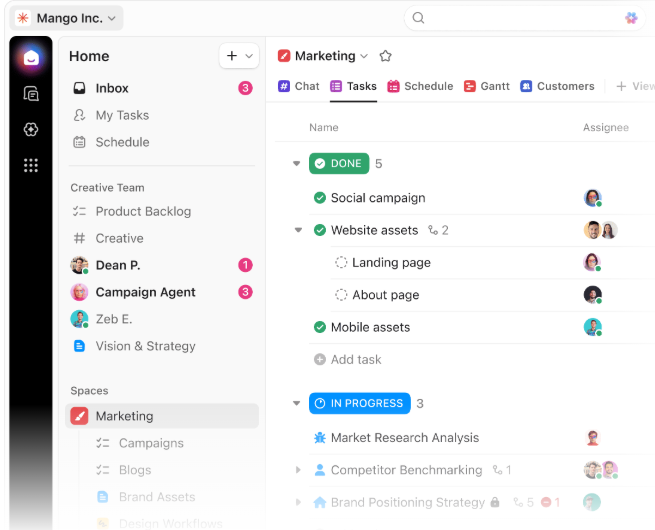
Every startup needs a single source of truth for who is doing what and when. ClickUp delivers that — and a great deal more — at a price point that makes it the most feature-dense project management tool per dollar available in 2026.
ClickUp’s free plan supports unlimited users, unlimited tasks, and 15+ views including List, Board, Gantt, Calendar, and Mind Map. That is not a stripped-down trial — it is a fully functional project management workspace that most early-stage teams can run on indefinitely.
Key features:
- 15+ views (List, Kanban, Gantt, Calendar, Workload, Mind Map, Whiteboard)
- Native Docs, Whiteboards, and time tracking built in — no add-ons required
- ClickUp Brain AI for task summaries, writing assistance, and automated status updates
- 1,000+ integrations including GitHub, Slack, Zoom, HubSpot, and Zapier
- Custom fields, automations, and sprint management on paid plans
Why startups choose it: ClickUp replaces four or five separate tools — project tracker, wiki, whiteboard, time tracker, and meeting notes — with a single subscription. For lean teams, that consolidation saves both money and the cognitive overhead of tool-switching.
Best Alternatives
Asana (cleaner UI, better for cross-functional teams), Monday.com (fastest adoption, strongest visual boards), Notion (best for documentation-heavy workflows), Linear (built specifically for software engineering teams).
2. Slack – Best SaaS Tool for Team Communication and Collaboration
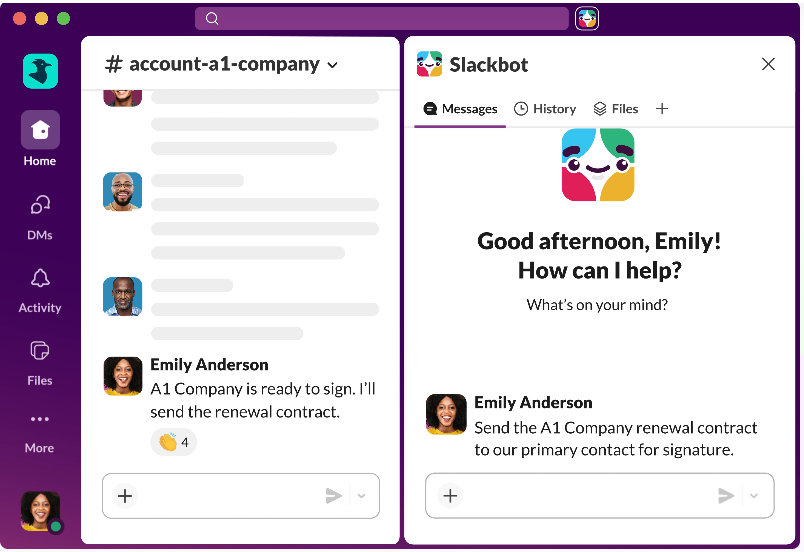
In early 2026, Slack reached over 47.2 million daily active users — making it the dominant team communication platform for startups globally. The reason is straightforward: Slack replaced the internal email thread with a faster, more organized, searchable alternative that actually reflects how modern teams communicate.
Channels, direct messages, Huddles (lightweight voice and video), and Clips (async video messages) give distributed and remote startup teams the full range of communication options without needing a separate meeting tool for every conversation.
Key features:
- Organized channels by project, team, department, or topic
- 90-day message history on the free plan (full archive on paid)
- Slack Huddles for instant voice and screen-share calls
- Workflow Builder for automating routine notifications and handoffs
- 2,600+ app integrations via the Slack App Directory
- AI-powered search and channel summaries (paid plans)
Why startups choose it: Communication speed is a direct competitive advantage at the early stage. Slack keeps decisions, updates, and context searchable and accessible — reducing the “I didn’t know that was decided” problem that kills early-stage coordination.
Best Alternatives
Microsoft Teams (better for Microsoft 365 shops), Discord (popular with dev-heavy startups), Google Chat (included free with Google Workspace), Lark (strong for Asia-Pacific distributed teams).
3. Google Workspace – Best SaaS Tool for Email, File Storage, and Docs
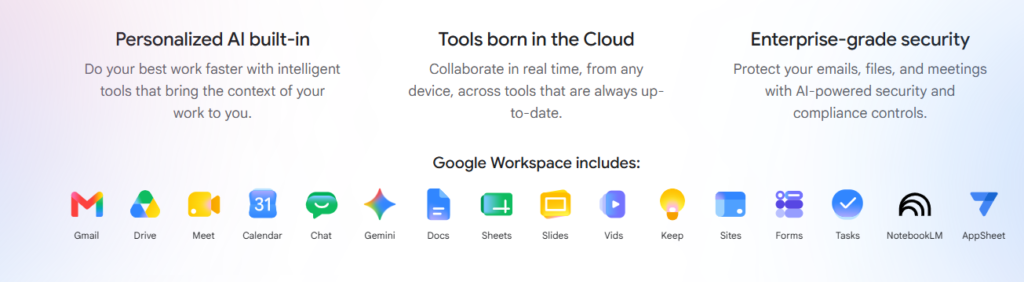
Google Workspace is the foundational layer of most US startup tech stacks. Gmail, Google Docs, Sheets, Slides, Drive, and Meet — all under one subscription, all sharing the same contact model and permission system.
For startups that run on collaboration, Google Docs’ real-time co-editing is the single most important feature: no version conflicts, no emailing attachments, no “which document is the final one” confusion.
Key features:
- Professional email with your own domain (yourname@yourcompany.com)
- Google Docs, Sheets, and Slides with real-time multi-user editing
- Google Drive with 30GB–5TB cloud storage per user (plan dependent)
- Google Meet for video conferencing (included with all plans)
- Google Calendar for shared scheduling
- Gemini AI assistant integrated across Gmail, Docs, Sheets (Business Standard+)
Why startups choose it: At $7/user/month (Business Starter), Google Workspace delivers professional email, office suite, cloud storage, and video conferencing for the same price as one standalone email tool. The integration density makes it the highest-value all-in-one for early-stage teams.
Best Alternatives
Microsoft 365 (better for enterprises running Outlook and Teams), Zoho Workplace (more affordable for very small teams), Proton Business Suite (for privacy-first teams).
4. Toggl Track – Best SaaS Tool for Time Tracking and Productivity
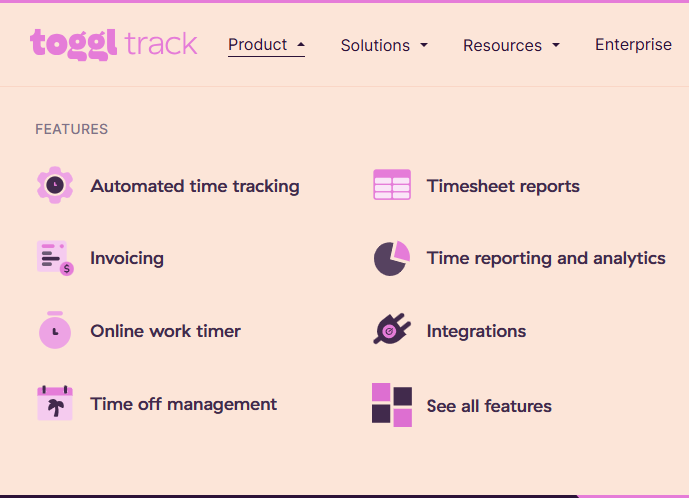
Time is the resource most startup founders underestimate. Toggl Track makes it visible — showing exactly where your team’s hours are going, which projects consume the most billable time, and where productivity is leaking.
For freelancers, agencies, and service-based startups, time tracking directly impacts invoicing accuracy. For product startups, it surfaces which work streams are absorbing time disproportionate to their priority.
Key features:
- One-click time tracking with browser extension, desktop app, and mobile
- Project and client tracking with color-coded timelines
- Billable hours reports and client invoice summaries
- Idle detection that reminds you to log time when you forget
- Toggl Track integrations with ClickUp, Asana, GitHub, Jira, and 100+ tools
- Free plan for up to 5 users — the most generous time tracking free tier available
Why startups choose it: Toggl Track has the simplest UX of any time tracking tool tested. New team members start tracking within 10 minutes of account creation. No configuration overhead, no mandatory fields, no friction.
Best Alternatives
Harvest (stronger invoice generation for agencies), Clockify (completely free for unlimited users, less polished), RescueTime (automatic tracking without manual entries), Timely (AI-powered automatic time capture).
5. Zoom – Best SaaS Tool for Video Conferencing and Virtual Meetings
Zoom is still the dominant video conferencing platform for US businesses in 2026 — not because of technical superiority over alternatives, but because of universal recognition. Every client, investor, and vendor your startup talks to knows how to join a Zoom call without any explanation.
For startups building external relationships — investor pitches, client demos, partner calls, hiring interviews — Zoom’s familiarity removes friction that alternatives cannot match.
Key features:
- HD video with up to 1,000 participants on paid plans
- AI Companion for meeting summaries, action items, and transcript generation
- Breakout rooms, waiting rooms, and host controls
- Zoom Clips for short async video messages
- Recording with cloud storage (paid plans)
- Integrated with Google Calendar, HubSpot, Slack, and 1,500+ apps
Why startups choose it: The free plan handles most early-stage external calls — 40-minute unlimited one-on-ones and group meetings. Upgrade to Pro ($15.99/month) when you need longer group calls, recording, or AI meeting summaries.
Best Alternatives
Google Meet (free with Google Workspace, stronger default security), Microsoft Teams (better for internal enterprise meetings), Loom (for calls where async video would work better), Riverside.fm (for recorded podcast or interview content).
6. Loom – Best SaaS Tool for Async Video Messaging and Screen Recording
Not every conversation needs a meeting. Loom fills the gap between “send a quick message” and “schedule a 30-minute call” — letting you record your screen, face, or both, and share the video in seconds with anyone via a link.
For remote and distributed startup teams, Loom reduces meeting overload dramatically. A two-minute Loom explaining a UI decision, a code review, or an investor update reaches the same audience as a 30-minute synchronous call — at a time that works for everyone.
Key features:
- Screen + camera recording in one click from browser or desktop app
- AI-powered transcripts, chapter markers, and summaries
- Viewer engagement analytics (who watched, when, and how much)
- Comments and emoji reactions directly on the video timeline
- Loom AI for auto-generating video titles, summaries, and follow-up tasks
- Free plan includes 25 videos up to 5 minutes each
Why startups choose it: Loom has the highest-value free plan of any async video tool. For early-stage teams, 25 videos per creator covers most real use cases. The paid plan ($12.50/user/month) removes all limits and adds AI features.
Best Alternatives
Vidyard (stronger for sales video prospecting), Riverside.fm (higher quality recording for external-facing content), Slack Clips (embedded into Slack conversations), Notion’s built-in record feature (for in-document demos).
7. HubSpot – Best SaaS Tool for CRM and Inbound Marketing
HubSpot is the most generous free tool in this entire list. The free CRM supports unlimited users, unlimited contacts, and a fully functional deal pipeline — with no time limit and no credit card required.
For early-stage startups, HubSpot’s free CRM builds the sales habit — consistent contact logging, pipeline visibility, and email tracking — before there is any budget to spend on automation.
Key features (Free CRM):
- Unlimited contacts, companies, and deals
- Visual sales pipeline with drag-and-drop deal management
- Email tracking and open notifications
- Meeting scheduler with calendar sync
- Live chat and chatbot for your website
- HubSpot Breeze AI for deal summaries, email drafts, and content generation (paid plans)
Why startups choose it: HubSpot’s upgrade path from free to Starter ($15/month) to Professional ($90/month) is the smoothest in the CRM market — no data migration required, no retraining the team, no new login. The platform grows with you.
Best Alternatives
Pipedrive (better pipeline management for pure sales teams), Zoho CRM (more affordable for growing teams), Salesforce Starter ($25/user/month for teams planning to scale into enterprise CRM), Attio (modern, flexible interface popular with YC-backed startups).
8. Canva – Best SaaS Tool for Graphic Design and Content Creation
Not every startup has a designer. Canva solves this problem by making professional-quality visual content accessible to anyone — no design experience, no Adobe license, no 40-hour learning curve.
Social media graphics, pitch deck slides, email headers, blog post banners, investor one-pagers, and product screenshots all live in Canva — organized, branded, and accessible to your entire team from any device.
Key features:
- 250,000+ templates across social media, presentations, documents, and more
- Canva AI: text-to-image, background removal, Magic Write (AI copywriting), and image generation
- Brand Kit for consistent colors, fonts, and logo usage across every asset
- Team collaboration with comments and approval workflows
- Canva Pro includes 1TB storage, premium templates, and unlimited brand kits
- Free plan is one of the most extensive in the design category
Why startups choose it: Canva’s free plan covers the vast majority of early-stage design needs. The Pro plan at $15/month delivers more value than hiring a freelance designer for recurring content needs.
Best Alternatives
Adobe Express (strong for Adobe ecosystem users), Figma (better for product UI/UX design), Visme (stronger for data visualization and infographics), Piktochart (best for reports and presentations with charts).
9. Mailchimp – Best SaaS Tool for Email Marketing and Automation
Email is still the highest-ROI marketing channel in 2026, returning an average of $36 for every $1 spent. Mailchimp is the tool most US startups reach for first — familiar, well-documented, and generous enough on the free plan to validate your email strategy before you spend anything.
For startups building a subscriber list, running product launch sequences, or nurturing leads from HubSpot, Mailchimp handles the operational side of email without requiring a marketing operations hire.
Key features:
- Drag-and-drop email builder with 100+ pre-built templates
- Free plan for up to 500 contacts and 1,000 monthly sends
- Email automation sequences (welcome, abandoned cart, post-purchase)
- A/B testing for subject lines, send times, and content
- Audience segmentation based on behavior, location, and tags
- Mailchimp AI: subject line suggestions, send time optimization, and content generation
Why startups choose it: The free plan is genuinely usable for early-stage lists. The upgrade to Essentials ($13/month for up to 500 contacts, unlimited sends) removes the send limit and adds A/B testing — the two features most active senders need first.
Best Alternatives
ConvertKit / Kit (better for creators and personal brands), ActiveCampaign (stronger automation for sales-integrated email), Klaviyo (built for e-commerce, superior segmentation), MailerLite (better value than Mailchimp at equivalent contact counts).
10. Ahrefs – Best SaaS Tool for SEO and Content Research
If content or organic search is part of your growth strategy, Ahrefs is the most complete SEO intelligence platform available. It tells you what keywords your target audience is searching for, which competitors are ranking for those terms, and what it would realistically take to outrank them.
For startups building inbound content programs, Ahrefs compresses years of trial-and-error into data-driven decisions: which topics to target, which pages to build first, and which backlinks to pursue.
Key features:
- Site Explorer: full traffic and backlink analysis for any domain
- Keywords Explorer: search volume, keyword difficulty, and click potential for 10+ billion keywords
- Content Explorer: find the top-performing content on any topic by traffic, links, and social shares
- Site Audit: automated technical SEO health checks
- Rank Tracker: monitor your keyword positions over time
- Ahrefs Starter plan at $29/month — the most affordable entry to serious SEO data
Why startups choose it: At the Starter tier, Ahrefs delivers enough keyword, competitor, and backlink data to build and execute a full content strategy. For teams prioritizing organic growth over paid acquisition, it is the highest-leverage $29/month in their stack.
Best Alternatives
Semrush (stronger for paid ads research, more expensive), Moz Pro (better community and link research tools), Ubersuggest (affordable alternative for early-stage teams on tight budgets), Google Search Console (free, essential regardless of which paid tool you use).
Conclusion & Final Thoughts
The 10 tools in this guide cover every critical operational layer of a US startup in 2026: how your team works together, how you track time and projects, how you communicate internally and externally, how you acquire and manage customers, and how you grow your audience.
You do not need to purchase every piece of software on day one. Start by identifying your biggest bottleneck and pick the tool that directly solves that problem.
The sequence that works for most early-stage startups:
- Week 1: Google Workspace (email + docs), Slack (team communication), ClickUp (project tracking)
- Month 1: HubSpot free CRM (contact management), Canva (design), Zoom (client calls)
- Month 2–3: Loom (async video), Toggl Track (time visibility), Mailchimp (email list)
- Month 3–6: Ahrefs (SEO) once content becomes a channel worth investing in
Build the stack progressively. Consolidate before adding. And audit every tool quarterly — the ones your team does not open consistently are the ones worth dropping.
FAQs
What are the best free SaaS tools for startups?
HubSpot (free CRM), ClickUp (free project management), Canva (free design), Slack (free communication), and Toggl Track (free time tracking) all offer genuinely useful free tiers with no time expiration.
How much should a startup budget for SaaS tools?
Early-stage startups (under 10 people) typically run a complete operational stack for $150–$300/month. Growth-stage teams of 25+ typically spend $500–$1,500/month depending on CRM and marketing automation tier.
Which SaaS tool is most important for a startup?
A CRM (HubSpot) and a project management tool (ClickUp) are the two highest-priority tools — they determine how you track customers and how your team tracks work, both of which directly affect revenue.
Can startups get discounts on SaaS tools?
Yes. Most SaaS tools offer 20–40% discounts for annual billing. Startup programs from HubSpot, Slack, Google, Zoom, and Canva also offer discounted or free access for qualifying early-stage companies. Check each tool’s official startup program page.
Is Google Workspace better than Microsoft 365 for startups?
For most US startups — yes. Google Workspace is simpler, more collaborative by default, and integrates better with tools like HubSpot, Slack, and Zapier. Microsoft 365 is better if your team already has strong Excel or PowerPoint workflows.
Which email marketing tool is best for startups under 500 contacts?
Mailchimp’s free plan (500 contacts, 1,000 sends/month) is the best starting point. For creators and personal brands, Kit (ConvertKit) is a strong alternative. For e-commerce, Klaviyo’s free plan handles up to 250 contacts with superior segmentation.
Does Ahrefs have a free plan?
No. Ahrefs starts at $29/month (Starter). Google Search Console is free and essential regardless of which paid SEO tool you choose — always set it up first.
Disclaimer: Content on Next Byte Blog is for informational purposes only. Pricing and features mentioned are based on data available at the time of writing and may have changed. We are not affiliated with any tools or platforms mentioned unless stated. Some links may be affiliate links. Always verify information directly with the official source before making decisions.

Muneeb Azhar is the founder, publisher, and lead author of Next Byte Blog. A full-time professional freelancer specializing in SaaS, developer tools, and software reviews, he brings hands-on product experience to every piece he writes. His work covers best-of tool roundups, in-depth comparisons, and honest reviews of both free and paid software — helping readers make smarter decisions without the guesswork.