Key Takeaways Best API Testing Tools
- Postman is the gold standard for enterprise teams needing deep collaboration, automation, and a mature API lifecycle platform.
- Insomnia is the top pick for GraphQL-heavy projects and developers who value a clean, distraction-free interface.
- Thunder Client is unbeatable for solo VS Code developers who want zero context-switching.
- HTTPie is the friendliest entry point for beginners and CLI-first workflows.
- Over 58% of developers cite cost as their top factor when choosing an API tool — meaning the right tool depends on your budget as much as your stack.
- All four tools support Postman collection imports, making migration straightforward.
Why API Testing Is Critical in 2026

Choosing the wrong API client can ruin your development workflow. In this guide, we look at the four best tools for 2026 based on real-world team collaboration, speed, and pricing.
In 2026, software teams ship faster than ever. Microservices have replaced monoliths. Frontend and backend teams work in parallel. CI/CD pipelines run dozens of deployments a day. In that environment, an untested API isn’t just a bug waiting to happen, it’s a responsibility that can bring down production for an organization.
According to Postman’s own State of the API Report, over 76% of organizations now consider APIs central to their digital transformation strategy. That number makes sense. APIs are the connective tissue between your services, your third-party integrations, your mobile clients, and your web applications.
The right API testing tool keeps your endpoints reliable, your response times fast, and your team aligned. The wrong one slows you down, inflates costs, or locks your workflow inside a platform that doesn’t fit how you actually work. That’s exactly why the conversation around the best API testing tools has gotten louder in recent years.
Postman: The Industry Standard
Postman started as a simple Chrome extension back in 2012. Today it’s a full API lifecycle platform with over 30 million registered users, enterprise-grade collaboration features, mock servers, API monitoring, and a massive marketplace of integrations.
If you’ve ever worked on a software team, you’ve probably used Postman. It’s the default. Teams default to it because it works, because everyone knows it, and because its ecosystem is unmatched.
What Postman does well:
- Complete API lifecycle management from design to monitoring
- Team workspaces with role-based access and real-time collaboration
- Newman CLI for running collections inside CI/CD pipelines
- Built-in mock servers, API documentation, and API monitoring
- Integrations with Jira, GitHub, Slack, AWS, and dozens more
- Support for REST, GraphQL, gRPC, WebSocket, and SOAP
Where Postman falls short:
- The desktop app is Electron-based and can feel sluggish with large collections
- Free plan restrictions (introduced in 2023) pushed many individual developers away
- Paid plans can get expensive fast — especially for larger teams
- The interface has grown complex over time; new users face a real learning curve
Pricing: Free tier available. Professional plans start at $14/user/month. Enterprise pricing is custom.
Best for: Mid-to-large teams, enterprise environments, and any workflow that needs pipeline automation via the Newman CLI.
Insomnia: Developer-First Design
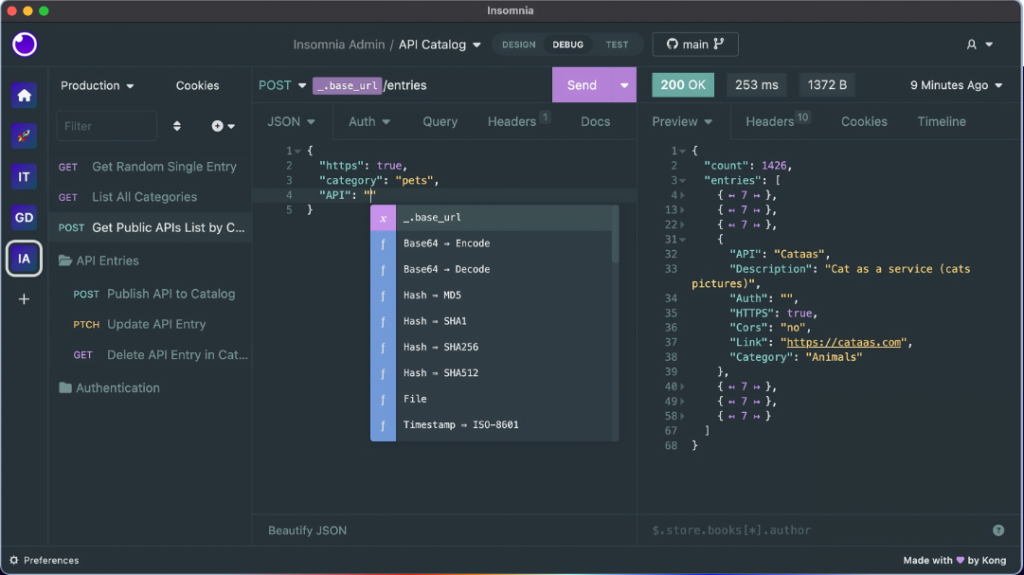
Insomnia was acquired by Kong in 2019, and it has matured into one of the most thoughtfully designed API clients available. It isn’t trying to be everything Postman is. Instead, it focuses on being genuinely pleasant to use every single day.
What makes Insomnia stand out is its flexible storage architecture. Unlike tools that force you into the cloud, Insomnia lets you choose: Scratch Pad (fully local, no account needed), Local Vault (local storage with account features), or Cloud Sync (full team collaboration). You can even set this per project keeping sensitive internal collections local while syncing shared team APIs to the cloud.
Insomnia 12, released in 2026, added native MCP (Model Context Protocol) client support making it one of the first API clients purpose-built to test and debug AI tool integrations. That’s forward-thinking product work you won’t find in most competitors.
What Insomnia does well:
- Clean, fast, and genuinely enjoyable interface
- Best-in-class GraphQL support with introspection and query variables
- Flexible per-project storage (local, vault, or cloud)
- Plugin system for extending core functionality
- Native support for REST, GraphQL, gRPC, WebSocket, and SSE
- Git sync for version-controlling your API collections
Where Insomnia falls short:
- No Newman-style CLI equivalent — a hard stop for automated pipeline testing
- Some past decisions (like the 2022 mandatory account controversy) eroded community trust
- Electron-based, so memory usage is higher than truly lightweight alternatives
- Team features require paid plans
Pricing: Free tier (local only). Team plans start at $7/user/month.
Best for: Small-to-medium teams, GraphQL-heavy projects, and developers who prioritize UX and data privacy over full platform breadth.
Thunder Client: Lightweight VS Code Extension
Thunder Client launched in 2021 with a single, clear idea: why should developers leave their code editor to test an API? If you spend your day inside VS Code, switching to a separate application — even a great one — adds friction. Thunder Client eliminates that friction entirely.
It lives in the VS Code sidebar. You write code, you test your endpoint, you adjust, you test again — all without touching your taskbar. For solo developers or small teams with tight feedback loops, that workflow efficiency is genuinely valuable.
What Thunder Client does well:
- Zero context-switching — API testing lives inside VS Code
- Lightweight and fast, even on modest hardware
- Supports collections, environments, and basic test scripts
- Free tier covers the core use case with no usage limits
- Has a CLI version for lightweight automation needs
- Supports WebSocket, SSE, and gRPC (on paid plans)
Where Thunder Client falls short:
- Limited collaboration features — not built for larger teams
- Feature set can’t match full standalone clients like Postman
- Free tier has been scaled back; some previously free features now require Pro
- Smaller community and less documentation than Postman or Insomnia
Pricing: Free tier available. Pro plan at $4/month (or $40/year) adds cloud sync and team sharing.
Best for: Individual developers and small teams who work primarily in VS Code and want the fastest possible testing workflow.
HTTPie: Beautiful and Beginner-Friendly
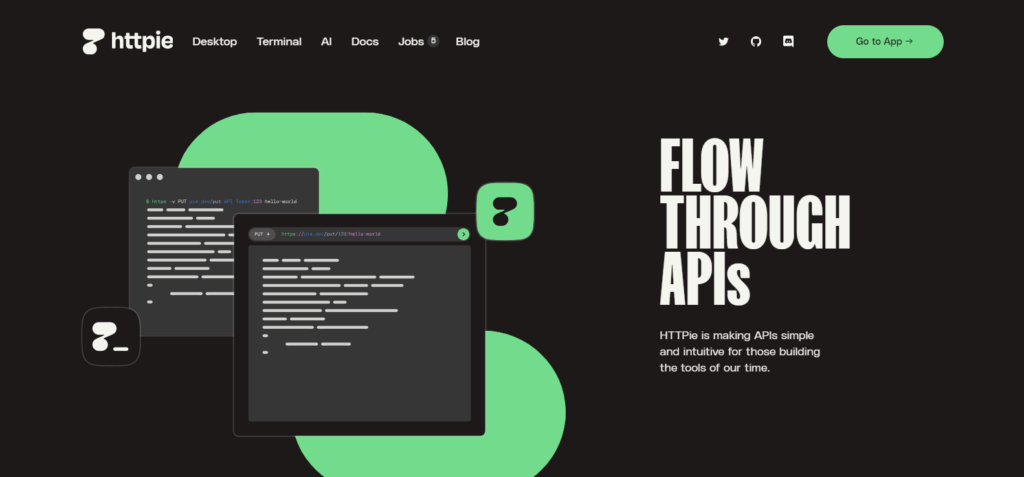
HTTPie takes a different approach to the whole category. It started as a command-line tool built on a simple premise: cURL is powerful, but it’s hard to read and harder to write. HTTPie gives you a CLI where http GET api.example.com/users is the actual command no flags to memorize, no quote-wrestling, no piping through jq just to read JSON.
The CLI is open source (BSD-3-Clause) and completely free. The desktop app is a separate, closed-source product that adds a GUI layer on top of the same ergonomic philosophy. If you’re evaluating HTTPie, make sure you know which product you’re actually looking at — they’re meaningfully different.
What HTTPie does well:
- Human-readable syntax that dramatically reduces CLI complexity
- Syntax-highlighted output by default — no extra tooling required
- Session persistence for maintaining auth and headers across requests
- Completely free and open-source CLI
- Excellent for automation scripts, DevOps workflows, and shell pipelines
- Beginner-friendly — lowers the learning curve for developers new to API testing
Where HTTPie falls short:
- CLI has no collections, visual environment management, or point-and-click UI
- Desktop app is proprietary and paid — different product from the CLI
- Not ideal for teams that need collaboration features
- No built-in test scripting or CI/CD pipeline integration
Pricing: CLI is free and open source. Desktop app pricing available on the official HTTPie site.
Best for: CLI-first developers, DevOps engineers, and beginners learning API testing for the first time.
Head-to-Head Comparison
| Feature | Postman | Insomnia | Thunder Client | HTTPie |
|---|---|---|---|---|
| Platform | Desktop + Web | Desktop | VS Code Extension | CLI + Desktop |
| Free Tier | Limited | Local only | Yes (basic) | CLI free |
| Paid Starting Price | $14/user/mo | $7/user/mo | $4/mo | Varies |
| GraphQL Support | Good | Excellent | Basic | Limited |
| gRPC Support | Yes | Yes | Paid plan | No |
| CI/CD Integration | Yes (Newman) | No CLI | Limited | Yes (CLI) |
| Collaboration | Extensive | Good | Basic | None |
| Git Sync | Yes | Yes | No | No |
| Learning Curve | Steep | Moderate | Gentle | Gentle |
| Best For | Enterprise teams | Mid-size teams | Solo devs | CLI users |
| Open Source | No | Partial (Apache-2.0) | No | CLI only |
How to Choose the Right API Testing Tool
There’s no single best tool — only the best tool for your specific situation. Here’s a practical decision framework:
Choose Postman if:
- Your team has more than 10 developers who need real-time collaboration
- You run automated API tests inside a CI/CD pipeline (Newman is indispensable here)
- You need mock servers, API monitoring, or full lifecycle management
- Enterprise compliance, SSO, and RBAC are requirements
Choose Insomnia if:
- Your stack is GraphQL-heavy and you want native introspection support
- Privacy matters — you need local-only storage for sensitive API collections
- You want a clean, fast daily driver that’s easier to navigate than Postman
- Your team is small-to-medium and doesn’t need pipeline automation yet
Choose Thunder Client if:
- You live inside VS Code and hate context-switching
- You’re a solo developer or working in a small team
- Speed of setup matters — Thunder Client is running in under two minutes
- You want the lowest possible cost for essential API testing
Choose HTTPie if:
- You’re comfortable in the terminal and want something more ergonomic than cURL
- You’re building automation scripts that need clean HTTP interaction
- You’re new to API testing and want the gentlest learning curve possible
- You’re a DevOps engineer who needs a reliable CLI HTTP client in shell pipelines
One practical insight from real-world usage: many developers use more than one tool. Thunder Client handles quick tests during active development. Postman or Insomnia manages shared team collections and regression suites. HTTPie handles shell scripts and automation. They’re not mutually exclusive.
Conclusion
The best API testing tools in 2026 serve distinctly different needs — and the market has matured enough that you don’t have to settle.
Postman remains the enterprise standard. Its collaboration depth, Newman CLI, and ecosystem integrations are unmatched. But its pricing and complexity make it overkill for small teams or individual developers.
Insomnia is the best daily driver for developers who care about interface quality and data privacy. Its flexible per-project storage model and industry-leading GraphQL support make it the smart choice for most mid-size teams.
Thunder Client wins on workflow integration for VS Code users. If your editor is your world, Thunder Client keeps your API testing inside it — at a price point that’s hard to argue with.
HTTPie earns its spot by being genuinely beginner-friendly and genuinely powerful for CLI workflows. Its open-source CLI is one of the cleanest HTTP tools ever built.
Start with the free tier of whichever tool fits your primary workflow. All four import Postman collections, so switching later is never as painful as it sounds.
FAQs
What is the best free API testing tool in 2026?
Thunder Client and HTTPie’s CLI offer the most generous free tiers. For full-featured GUI testing without cost, Thunder Client’s free VS Code extension is the top pick.
Is Insomnia better than Postman?
For GraphQL-heavy workflows and cleaner UX, yes. For enterprise collaboration and CI/CD automation via Newman, Postman still leads.
Can Thunder Client replace Postman?
For solo developers working in VS Code, absolutely. For teams needing deep collaboration or pipeline automation, Thunder Client’s feature set falls short.
Does HTTPie work for REST and GraphQL?
HTTPie’s CLI is excellent for REST APIs. GraphQL support is limited — for complex GraphQL workflows, Insomnia is the stronger choice.
Which API testing tool is best for CI/CD pipelines?
Postman’s Newman CLI is the most mature option. HTTPie’s CLI also works well for scripting HTTP calls inside pipeline steps.
Are these tools compatible with each other’s collections?
Yes. Postman, Insomnia, and Thunder Client all support Postman collection imports, making migration between tools straightforward.
Is Postman open source?
No. Insomnia is partially open source (Apache-2.0 license). HTTPie’s CLI is open source (BSD-3-Clause). Bruno (not covered here) is the most fully open-source option.
Last updated: May 2026. Pricing information is subject to change — always verify on each tool’s official website before purchasing.
More Blogs
Latest Posts
- Flock Review 2026: Ease of Use, Pricing, and Features
 Since 2014, Flock has been quietly catering to small and mid-sized businesses, lacking in name recognition compared…
 - Webex Pricing Guide for 2026: Free, Unlimited, and Business Plans Explained
 Webex is the enterprise communication solution offered by Cisco, one of the most reliable brands in video…
 - Zenzap Review 2026: Best Communication Tool For Business, Communities, and Groups?
 It is an unfortunate reality that every team faces at some point: key business decisions lost in…
 - Top 10 Affordable and Easy-to-Use Jira Alternatives in 2026 (Based on Real Testing)
 If you’ve ever spent 30 minutes trying to figure out how to configure Jira for a basic…
 - Slack Pricing Explained in 2026: Free Plan, and Paid Plans
 When considering using Slack for your organization, the initial thing that comes to your mind would definitely…
 - Top 10 monday.com Alternatives That Are Actually Affordable and Scalable (2026): Based on Real Testing
 monday.com is undoubtedly an excellent visual project management tool. Thanks to its visual features like color-coding of…

Muneeb Azhar is the founder, publisher, and lead author of Next Byte Blog. A full-time professional freelancer specializing in SaaS, developer tools, and software reviews, he brings hands-on product experience to every piece he writes. His work covers best-of tool roundups, in-depth comparisons, and honest reviews of both free and paid software — helping readers make smarter decisions without the guesswork.