It’s not just a methodology for software development anymore; in 2026, agile project management practices are used by engineering, product, marketing, and even HR departments. But an agile project management software solution transforms the methodology into a functional system that delivers projects in a timely manner.
The problem here is that there’s never been a greater variety of agile project management software solutions available. All of them claim to offer agile support through scrum and/or kanban, yet the gap between agile PM software that facilitates the process and makes things slower than before by adding extra configuration can be vast.
This guide reviews 10 of the most effective agile project management software solutions in 2026 – ranked according to their usability in the USA, with verified pricing and honest evaluations and use cases.
Key Takeaways: Best Agile Project Management Software
| Tool | Best For | Free Plan | Starting Paid Price |
|---|---|---|---|
| Jira | Structured sprint planning, engineering teams | ✅ Up to 10 users | $7.91/user/month |
| Zoho Sprints | Lightweight scrum on a budget | ✅ Up to 3 users | $1/user/month |
| ClickUp | Free all-in-one agile for any team | ✅ Unlimited users | $7/user/month |
| Asana | Visual agile planning, cross-functional teams | ✅ Up to 10 users | $10.99/user/month |
| Nifty | Collaboration-heavy product teams | ✅ Yes | $39/month (Starter) |
| Trello | Simple kanban for small agile teams | ✅ 10 boards | $5/user/month |
| monday.com | Highly visual agile work management | ✅ 2 users | $12/seat/month |
| Wrike | Scalable enterprise agile workflows | ✅ Unlimited users | $10/user/month |
| GitLab | End-to-end agile development with CI/CD | ✅ Unlimited users | $29/user/month |
| Azure Boards | Agile planning in the Microsoft ecosystem | ✅ Up to 5 users | $6/user/month |
Quick Comparison: Top 3 Agile Project Management Software
Jira
Best for: Structured Sprint Planning and Advanced Issue Tracking
In other words, Jira Software comes with Scrum and Kanban done right due to its extensive app marketplace and flexible issue tracking system. It is a natural choice for engineering teams that conduct agile ceremonies because all the components necessary for an agile methodology come out-of-the-box with Jira.
Zoho Sprints
Best for: Lightweight Scrum and Kanban-Based Sprints
The application Zoho Sprints has been designed keeping in mind Scrum teams and comes complete with backlogs, sprint planning, story points, and velocity measurement right from the beginning, all at an initial cost of $1/user/month that makes it way cheaper than alternatives available. The application suits small-to-medium sized development teams seeking Scrum processes without paying high prices.
ClickUp

Best for: Customizable Agile Workflows That Adapt Based on Needs
ClickUp comes out on top as the best free agile project management tool because it offers users the ability to use agile project management specific functionality for free, including unlimited tasks and users within its free package. There’s no other free option like ClickUp that offers users the flexibility of viewing their projects from different angles.
Our Pick: Jira Is the Top Agile Software
Despite having tested all ten of these tools on actual sprint processes, Jira continues to be the best among all options for US-based engineering teams in 2026. Jira boasts a very flexible environment that is capable of delivering robust sprint planning, product backlogs management, and reporting for an agile team – giving Jira the ability to fit into any process. The free tier offers a solution for 10 people, while the Standard plan costs $7.91/user/month and includes audit logs and permission management.
In terms of an extensive range of features at an affordable cost, for non-development teams using the agile process, ClickUp tops this list. As for formal scrum teams operating on a shoestring budget, the best solution is Zoho Sprints at $1 per user monthly.
Best Agile Project Management Software
Jira
Best for: Structured Sprint Planning and Advanced Issue Tracking
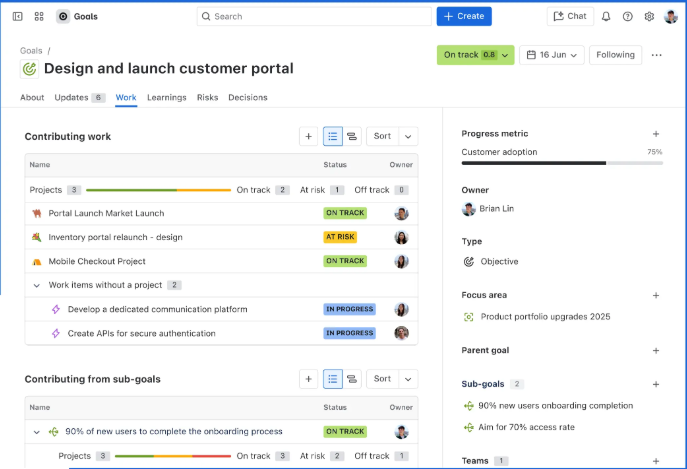
Jira is the most widely adopted agile project management tool in the world, having been utilized by more than 300,000 companies around the globe. The structure of this system resembles the agile framework in itself; starting from creating an epic, splitting it up into user stories, estimating story points, assigning the task to a sprint, and monitoring its progress using a scrum board and burndown graph.
What makes Jira the top choice:
- Backlog management: Rank, prioritize, and assign user stories from a centralized backlog visible to the entire team
- Sprint planning: Drag stories from the backlog into sprint slots with capacity-aware planning that prevents overcommitment
- Velocity charts: Historical sprint performance data that improves estimation accuracy with every completed sprint
- 3,000+ Marketplace integrations: GitHub, Confluence, PagerDuty, Slack, and the largest third-party ecosystem in the agile PM category
- Atlassian Intelligence AI: Sprint risk prediction, work summaries, and issue classification built into the platform
ClickUp delivers an all-in-one project management platform that consolidates multiple tools into a single, highly customizable workspace and excels at supporting diverse agile methodologies beyond traditional Scrum and Kanban.
Limitations: Steep learning curve for non-technical teams. Jira’s technical focus can create barriers when working with business stakeholders who need simpler, more visual project management approaches.
Pricing: Free (up to 10 users), Standard $7.91/user/month, Premium $14.54/user/month.
Other Things I Liked About Jira
- Custom issue types allow teams to track bugs, stories, epics, and tasks with type-specific workflow rules
- Swimlane views on sprint boards organize work by epic, assignee, or priority simultaneously
- Release management with version tracking connects sprint completion to deployable product increments
- Mobile app maintains full sprint board access for distributed and remote agile teams
Zoho Sprints
Best for: Lightweight Scrum and Kanban-Based Sprints
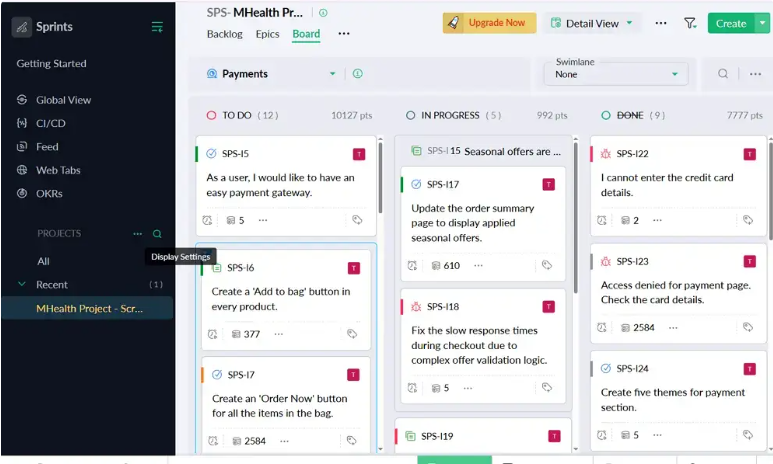
Zoho Sprints offers agile project management, custom tailored to development teams that wish to release projects faster but without the hassle that arises with the need to configure Jira. The simplicity of this application has been praised by users who mention that this contributes greatly to its high adoption rates.
If small to mid-sized US development teams are looking for a scrum-tailored application at a budget price, then Zoho Sprints’ $1/user/month price tag is unmatched among agile PM solutions.
Key features:
- Scrum board depicting the backlog and its progress, track-status timelines, and user story management for creating and managing project backlogs
- Burn-up and burn-down charts for sprint progress tracking
- Built-in time tracking and timesheets for logging sprint hours
- Velocity reports for improving sprint estimation over time
Limitations: Integrations beyond Zoho apps are fewer and less robust than industry leaders. Lacks deeper reporting like cumulative flow diagrams or detailed WIP metrics. Fewer options for tailoring workflows, fields, or reports compared to tools like Jira or ClickUp.
Pricing: Free (up to 3 users), paid from $1/user/month.
Other Things I Liked About Zoho Sprints
- Seamless integration with the broader Zoho ecosystem including Zoho Projects, Zoho CRM, and Zoho Analytics
- GitHub and GitLab integration for linking commits and pull requests to sprint tasks
- Centralized dashboard tracking KPIs and team velocity across multiple active sprints
- QA Touch integration for connecting test management directly to sprint boards
ClickUp
Best for: Customizable Agile Workflows That Adapt Based on Needs
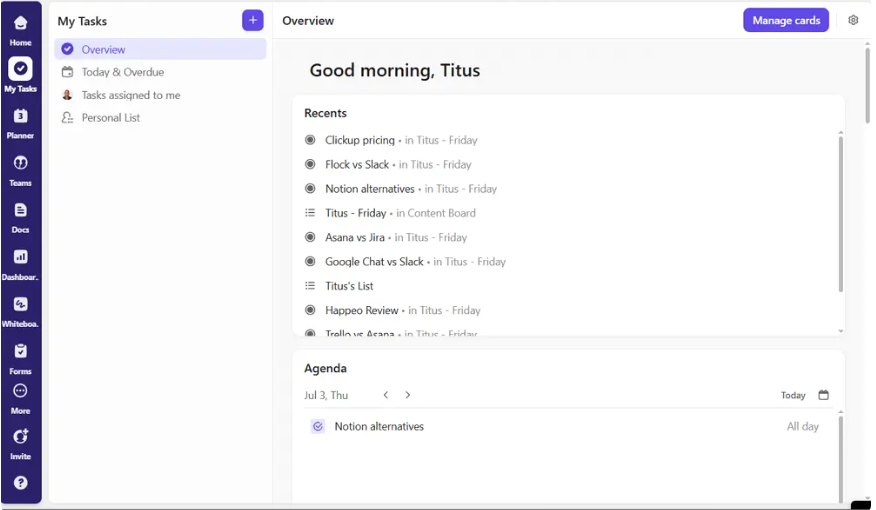
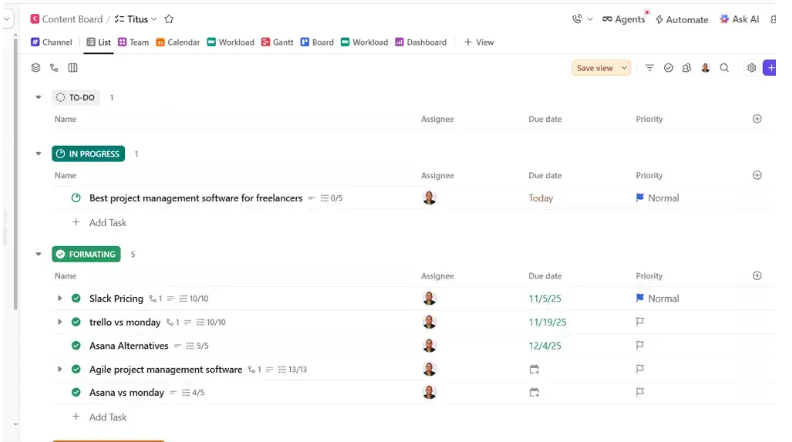
ClickUp is great for teams that are flexible and require a lot of built-in tools – it combines the ability to manage tasks, documents, and sprints in a single place. The Agile Sprint feature allows using both Scrum and Kanban methodologies, along with custom view types, sprint points, burndown charts, and velocity tracking.
In the case when teams get out of Trello’s scope, but still feel overwhelmed by Jira’s complexity, ClickUp provides a middle-ground solution with much less time to learn compared to Jira and more features than Trello.
Key features:
- Sprint planning with story point estimation and capacity management
- 15+ views: List, Board, Gantt, Calendar, Workload, Mind Map, and Sprint views
- ClickUp Brain AI for sprint summaries, automated status updates, and task generation
- Time tracking and time reporting without a third-party integration
- Built-in Docs connected to tasks for sprint documentation and team knowledge management
Limitations: Feature density creates onboarding overhead — new team members typically need 2–3 weeks to reach full productivity. Advanced reporting requires the Business plan ($12/user/month).
Pricing: Free Forever (unlimited users, core agile features), Unlimited $7/user/month, Business $12/user/month.
Other Things I Liked About ClickUp
- Custom sprint templates for recurring sprint ceremony workflows (standups, retrospectives, reviews)
- Dependency tracking across tasks and projects for multi-team sprint coordination
- Automations that update sprint status, reassign tasks, and notify team members without manual intervention
- 1,000+ integrations including GitHub, GitLab, Jenkins, HubSpot, and Zapier
Asana
Best for: Visual Agile Workflows
Asana is good at offering clean task planning and cross-functional collaboration through agile templates and timelines. Asana is best suited for small-sized teams that require structured agile workflows with clean visual task management.
The agile aspects of Asana are simple yet effective because they include task dependencies, timelines, workflow automation, all of which allow efficient completion of tasks without using technical terms.
Key features:
- Timeline view with dependency mapping across sprint tasks
- Agile workflow templates for sprint planning, retrospectives, and backlog grooming
- Unlimited automations on Starter plan for repetitive sprint ceremony tasks
- Asana AI Studio for work summaries and automated progress reporting
Limitations: Less powerful than Jira for engineering-specific agile workflows — no native story point estimation, no velocity charts on standard plans.
Pricing: Free (up to 10 users), Starter $10.99/user/month, Advanced $24.99/user/month.
Other Things I Liked About Asana
- Goals feature connects sprint outputs to business objectives for leadership visibility
- Forms-based intake routes new feature requests directly to the product backlog
- Guest access for external stakeholders who need visibility without full sprint board permissions
- Strong mobile apps for remote and distributed agile teams
Nifty
Best for: Collaboration-Heavy Teams
The Nifty project management software not only offers sprint management but also includes milestone tracking, team chat, Google Docs, and real-time collaboration features on one platform, which makes it the best choice for agile teams that communicate through the PM tool itself.
Key features:
- Sprint-based project planning with milestone tracking and team roadmaps
- Built-in team chat alongside task boards — reduces context-switching between PM tool and Slack
- Automated sprint progress reporting sent to stakeholders at configurable intervals
- Time tracking and workload management built into the platform
Limitations: Smaller integration ecosystem than Jira or ClickUp. Less mature analytics compared to established players.
Pricing: Free plan available, Starter $39/month (up to 10 members), Pro $79/month.
Other Things I Liked About Nifty
- Docs connected directly to sprint tasks — project documentation stays alongside the work it describes
- Guest access for external collaborators and client stakeholders
- Project templates for agile, scrum, and kanban workflows reduce initial setup time significantly
- Multi-team view for organizations managing multiple simultaneous agile projects
Trello
Best for: Simple Kanban-Based Agile Workflows
Trello is the best option for visual task management — its kanban board interface requires no agile training and produces a working sprint board in under 60 minutes. For small teams under 15 users, Trello provides enough features to get started with boards and backlogs to support agile ways of working.
For teams adopting agile for the first time — or departments transitioning from waterfall — Trello’s simplicity removes the adoption barrier that Jira and ClickUp can create.
Key features:
- Card-based kanban boards with drag-and-drop task progression
- Butler automation for recurring sprint ceremony tasks
- Power-Ups for adding timeline views, voting, and GitHub integration
- Unlimited cards and straightforward guest access on all plans
Limitations: No native sprint planning, no story point estimation, no velocity tracking. Agile ceremonies require manual processes or Power-Up additions.
Pricing: Free (10 boards), Standard $5/user/month, Premium $10/user/month.
Other Things I Liked About Trello
- Mirror cards allow tasks to appear across multiple boards simultaneously for cross-team visibility
- Template gallery includes pre-built agile and scrum board layouts
- Lowest onboarding time of any tool tested — productive within one hour of account creation
monday.com
Best for: Highly Visual Workflows
monday.com is a visual work OS that adapts to agile with templates and automations — making it the best choice for agile teams that want to manage sprints visually alongside other business workflows. Its column-based data model tracks every sprint variable (story points, assignee, status, priority, release date) in a single color-coded row.
Key features:
- Sprint planning board with customizable columns for every agile data point
- Dashboard views combining sprint metrics, workload data, and burndown tracking
- 25,000 automation actions per month on Pro for sprint ceremony automation
- monday Sidekick AI for sprint summaries and risk identification
Limitations: Not as engineering-native as Jira for deep agile metrics. Real power requires the Pro plan ($19/seat/month).
Pricing: Free (2 users), Basic $12/seat, Standard $14/seat, Pro $19/seat.
Other Things I Liked About monday.com
- Timeline view shows sprint dependencies across multiple teams simultaneously
- Client portal lets external stakeholders view sprint progress without full workspace access
- Workdocs connect sprint planning documents directly to the sprint board
Wrike
Best for: Scalable Agile Workflows
Wrike offers robust enterprise work management with custom item types and strong permissions — making it the strongest option for large organizations that need to scale agile across multiple departments while maintaining enterprise governance.
Cross-tagging allows sprint tasks to appear in both team-specific and project-specific views simultaneously — enabling multi-team sprint coordination without duplication.
Key features:
- Custom workflows with sprint-specific status labels and transition rules
- Resource management with workload visualization across active sprints
- Wrike Wit AI for sprint risk identification and automated status summaries
- Strong permissions model for client-facing agile teams
Pricing: Free (unlimited users), Team $10/user/month, Business $24.99/user/month.
Other Things I Liked About Wrike
- Visual proofing allows client review and approval directly on sprint deliverables
- Request forms route incoming work to the sprint backlog automatically
- Cross-team Gantt for managing sprint dependencies across multiple squads
GitLab
Best for: End-to-End Agile Development
GitLab integrates agile project management with source code management, CI/CD pipelines, and security scanning in a single platform — eliminating the Jira + GitHub + separate pipeline tool combination that many engineering teams maintain. For development teams who want their issue tracker, code repository, and CI/CD pipeline in one place, GitLab is the most complete end-to-end solution available.
Key features:
- Issues, epics, and milestones mapped directly to code commits and merge requests
- Built-in CI/CD pipeline management connected to sprint completion
- Kanban and scrum boards linked to the underlying code repository
- Security scanning integrated into the sprint delivery pipeline
Pricing: Free (unlimited users), Premium $29/user/month, Ultimate $99/user/month.
Other Things I Liked About GitLab
- Value stream analytics showing the full lifecycle from sprint planning to production deployment
- Roadmap views connected to epics and milestones across multiple development teams
- Merge request approval workflows integrated with sprint task completion status
Azure Boards
Best for: Agile Planning with Microsoft DevOps Workflows
Azure DevOps Boards delivers agile planning with tight CI/CD and repo integrations and generous starter pricing — making it the default choice for US organizations running Microsoft DevOps infrastructure. Azure Boards includes scrum boards, kanban boards, backlogs, queries, and sprint planning — all connected to Azure Repos and Azure Pipelines.
Key features:
- Scrum and kanban boards linked to Azure Repos commits and pull requests
- Work item tracking with customizable fields for bugs, user stories, and tasks
- Sprint planning with capacity management and burndown charts
- Microsoft Copilot AI integration for work item summaries and sprint planning assistance
Pricing: Free (up to 5 users), $6/user/month thereafter. Included with Visual Studio Enterprise subscription.
Other Things I Liked About Azure Boards
- Deep integration with Visual Studio, VS Code, and the full Microsoft 365 stack
- Delivery plans for cross-team sprint coordination across multiple Azure Boards projects
- Organization-level analytics with portfolio backlogs for program-level agile planning
What Is Agile Management Software?
Agile management software is a platform designed to support iterative, collaborative project delivery by organizing work into short cycles (sprints or iterations), visualizing work in progress (kanban boards), and measuring team performance (velocity, burndown, cycle time). It replaces the static Gantt chart model with a living, updated system that reflects actual team capacity and real-time delivery status.
The core agile PM software categories:
- Scrum-native tools: Designed around the sprint-based scrum framework — Jira, Zoho Sprints, and Azure Boards
- Kanban-first tools: Visualize continuous flow without fixed sprint timeboxes — Trello and monday.com
- All-in-one platforms: Support both scrum and kanban alongside documentation, time tracking, and communication — ClickUp, Nifty, and Wrike
- DevOps-integrated tools: Connect agile planning directly to code repositories and CI/CD pipelines — GitLab and Azure Boards
Key Features of Agile Management Platforms
The core capabilities that separate agile-ready PM tools from generic task managers:
- Sprint planning: Timeboxed work cycles with capacity management and backlog assignment
- Backlog management: A prioritized queue of user stories, bugs, and tasks pulled into sprints
- Kanban and scrum boards: Visual workflow visualization with WIP limits and swimlane support
- Velocity and burndown tracking: Quantified delivery metrics that improve estimation accuracy over time
- User story and epic management: Hierarchical work breakdown from business goals to individual tasks
- Dependency tracking: Identify blockers before they delay sprint completion
- Retrospective support: Structure for post-sprint review and continuous improvement cycles
Final Thoughts: Optimize Workflows With Agile Software
The right agile project management software depends on the specific intersection of your team’s size, technical sophistication, and delivery methodology:
- Software engineering teams running formal scrum → Jira (deepest agile feature set, largest ecosystem)
- Budget-conscious scrum teams → Zoho Sprints ($1/user/month, purpose-built for scrum)
- Free agile platform for any team → ClickUp (unlimited users, sprints, and views at zero cost)
- Cross-functional teams adopting agile → Asana (clean interface, minimal agile terminology barrier)
- Simple kanban for small teams → Trello (fastest setup, lowest learning curve)
- Visual work management across departments → monday.com (best dashboard and automation combination)
- Enterprise agile at scale → Wrike (strongest permissions and scalability)
- End-to-end dev pipeline → GitLab (code + agile + CI/CD in one platform)
- Microsoft DevOps stack → Azure Boards (native integration with Visual Studio and Azure)
The consistent finding across testing: the best agile project management software depends on how quickly your team plans to scale and how complex your workflows are. Start with the free plan of your top candidate, run one real sprint through it, and measure whether ceremonies became faster or slower. The answer will tell you everything you need to know.
Disclaimer: Content on Next Byte Blog is for informational purposes only. Pricing and features mentioned are based on data available at the time of writing and may have changed. We are not affiliated with any tools or platforms mentioned unless stated. Some links may be affiliate links. Always verify information directly with the official source before making decisions.

Muneeb Azhar is the founder, publisher, and lead author of Next Byte Blog. A full-time professional freelancer specializing in SaaS, developer tools, and software reviews, he brings hands-on product experience to every piece he writes. His work covers best-of tool roundups, in-depth comparisons, and honest reviews of both free and paid software — helping readers make smarter decisions without the guesswork.