Not all cloud-hosting services will be unsuitable for you. Most cloud-hosting services will be. Your need for a particular kind of application on an unsuitable platform will mean that the developers have to spend hours of time and, at times, sleep.
Cloud Hosting 2026: This will guide you with five platforms to the workloads where each genuinely wins, with 2026 pricing economics and a decision tree you can use today.
The Five Platforms in 60 Seconds
| Platform | Architecture | Core Strength | Starting Paid Price |
|---|---|---|---|
| Vercel | Serverless + Edge Functions | Next.js production, ISR, HIPAA | $20/seat/month (Pro) |
| Netlify | Build + Edge Functions (Deno) | Jamstack diversity, Astro, Hugo | $19/seat/month (Pro) |
| Cloudflare Pages/Workers | Edge-native, Workers runtime | Scale, cost, programmatic SEO | $5/month (Workers Paid) |
| Render | PaaS — Web + DB + Background | Full-stack with Postgres + runtime | $7/month (Web Service) |
| Fly.io | Global micro-VMs, Docker-native | Docker workloads, GPU, multi-region | $5/month minimum |
Free tier reality check for 2026:
- Cloudflare Pages is the most generous free hosting for static/Jamstack sites — unlimited bandwidth, 500 builds/month, 100 sites.
- Vercel Hobby is free but bans commercial use.
- Netlify moved to credit-based pricing (300 credits/month).
- Fly.io reduced its free tier to a 2-hour trial for new accounts.
- Render offers free web services with 512MB RAM and free PostgreSQL.
Where Each Platform Actually Wins
Vercel: Next.js Production, Healthcare Apps, Server Actions
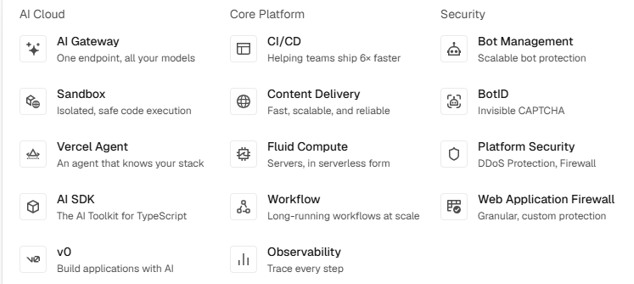
Purpose-built for Next.js.
Not “support” – purpose-built.
Server Components, Server Actions, Incremental Static Regeneration, image optimizations, and Edge Functions all operate without any modifications required. Just deploy and they work.
Server components, image optimization, and ISR work without configuration. Netlify and Cloudflare Pages both support Next.js but require more setup.
Where Vercel specifically wins:
- ISR at scale: ISR on Vercel works better for high-revalidation-frequency pages (news, prices, inventory) than any other option because the caching layer is part of the same infrastructure stack as the runtime.
- Server Actions: Next.js Server Actions support in the most recent set of features is somewhat lacking when it comes to use outside of Vercel. When deployed on Vercel, Server Actions perform consistently and can be observed via the deployment dashboard.
- HIPAA workloads: At $350/month, Vercel Pro BAA is the only offering of its kind among platforms here for Next.js-based HIPAA applications. No other Next.js platform has a similar BAA option at this price.
- Edge Middleware: Vercel’s Edge Middleware runs out of 100+ edge locations worldwide with sub-10ms latency for authentication, A/B testing, and geofencing without cold starts.
Where it falls short: Pro plan at $20/seat/month, Enterprise around $45K/year median. Per-seat pricing at scale: a team of 10 developers costs $200/month on Vercel before any compute charges. No Docker support. No native Postgres.
Netlify: Astro at Small Scale, Jamstack Diversity, Marketing Sites
Netlify was the first Jamstack platform, and even in 2026, it is still the one most agnostic to frameworks among the five. Netlify’s Edge Functions are powered by Deno, not V8 like Vercel’s, thus influencing their compatibility but offering a lightweight cold start process for some operations.
Where Netlify specifically wins:
- Astro, Hugo, Eleventy: No framework-specific configuration needed to deploy any static site generator with Netlify’s build pipeline. For those using Astro or Hugo in 2026, Netlify is the most straightforward choice for production deployment.
- Build Plugins: The plugin system for builds enables Netlify to handle image optimizations, accessibility, Lighthouse audits, etc., through plugins built by the community that don’t require setting up a separate CI/CD pipeline.
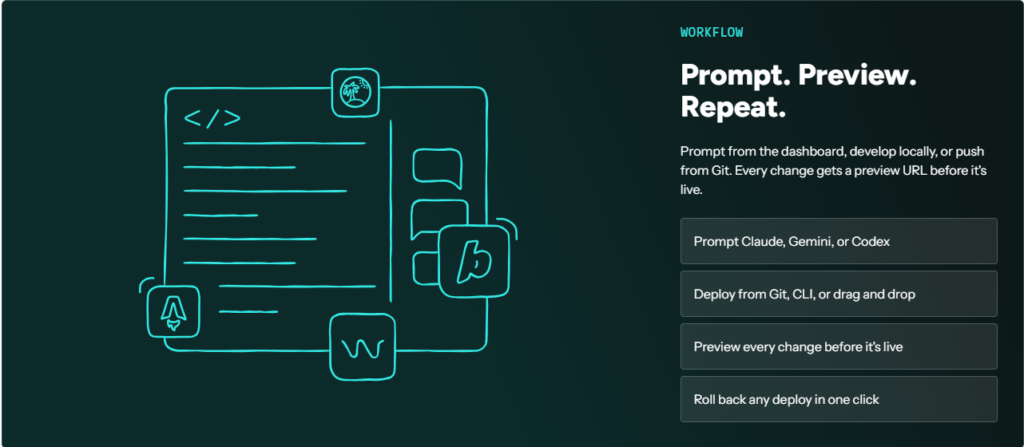
- Branch Deploys and Preview Environments: Netlify’s deploy previews are very well implemented. Each PR automatically gets its URL, and each branch is deployed separately, which fits in seamlessly with the workflow used on GitHub, GitLab, and Bitbucket.
- Forms & Identity: Netlify’s Forms and Identity features enable handling of form submissions and authentication for marketing websites with simple interactions without needing any server-side setup.
Shortcomings: Pricing model based on per-seat pricing is $19/seat, becoming increasingly expensive with the size of teams. Pricing using credits means unpredictability in monthly expenses. Inefficient in hosting Next.js in production.
Cloudflare Pages / Workers: Edge at Scale, Programmatic SEO, Low Cost
Cloudflare’s platform in 2026 is the most cost-efficient option for high-volume static and edge workloads. The free tier is genuinely useful: Workers Free handles 100,000 requests per day. Pages Free has unlimited bandwidth.
Cloudflare Workers free tier handles 100,000 requests/day — more than most early-stage products need. Performance at scale: Cloudflare Workers for edge-first architectures, sub-20ms globally, no cold starts.
Where Cloudflare specifically wins:
- Programmatic SEO sites at scale: A 25,000+ page content site on Vercel Pro hits bandwidth and build time costs that compound quickly. Cloudflare Pages serves the same site with unlimited bandwidth at $5/month for Workers Paid. The CDN is the deployment.
- No cold starts on Workers: Cloudflare Workers uses the V8 isolate model, no Node.js process startup, no container warm-up. Every request at any volume starts at the same consistent latency.
- KV + Durable Objects + R2: Cloudflare’s storage primitives (key-value, globally-consistent state, object storage) give edge Workers the data layer they need without routing requests back to an origin server. This architecture is uniquely suited for globally distributed read-heavy workloads.
- Cost at scale: Cloudflare wins on raw cost. Netlify and Vercel get expensive with team growth.
Where it falls short: Steepest DX learning curve of the five platforms. The Workers programming model is different from Node.js not all npm packages work. Next.js support via the Cloudflare adapter has historically lagged the Vercel feature set. Not the right choice if your team needs to move fast on an unfamiliar platform.
Render: Full-Stack Apps with Postgres and Runtime
Render occupies a specific and important position in the 2026 landscape: it is the platform for teams that need a web service, a Postgres database, and a static site under one subscription without the complexity of AWS or the per-seat pricing of Vercel.
Where Render specifically wins:
- Postgres: Render provides hosted Postgres in addition to its web and static site services. It therefore represents the simplest one-platform option for full stack applications where you do not wish to manage your database environment independently.
- Docker: With Render you can run your Docker containers straight away – any language, any framework, any dependencies. This is what gives Render the decisive edge that neither Vercel nor Netlify has.
- Background workers & Cron jobs: The background worker service offered by Render is an important feature as it enables the running of processes which cannot be done on a serverless platform – e.g. long-running, asynchronous tasks.
- Predictable pricing: Pricing for web service based on flat rates starting at $7/month ensures that there will be no unexpected charges for bandwidth usage or executions. Flat rate PaaS = Predictable Pricing, Docker, no bandwidth surprises.
Where it falls short: No edge network equivalent to Vercel or Cloudflare. Static sites on Render are served from a single region by default (though you can configure CDN). Not optimized for Next.js-specific features.
Fly.io: Docker-Shaped Global Deployment
Fly.io sits closest to raw infrastructure of the five platforms, but with a developer-friendly interface for global deployment. You write a Dockerfile, run fly deploy, and your application runs in micro-VMs across Fly’s global network — with traffic routed to the nearest region automatically.
Where Fly.io specifically wins:
- Multi-region runtime workloads: Applications that need to run actual server processes close to users — WebSocket servers, game backends, real-time APIs — are not a good fit for serverless. Fly.io handles them natively, with persistent VMs and automatic regional failover.
- GPU workloads: Fly.io’s GPU instance support makes it practical for AI inference, image processing, and ML workloads that cannot run on standard serverless runtimes.
- No enterprise pricing wall: Multi-region deployment on Vercel requires the Enterprise plan. On Fly.io, you pay for the compute you use, in the regions you deploy to, at a predictable per-resource rate.
- Volumes and stateful apps: Fly.io supports persistent volumes attached to VMs — enabling stateful applications (SQLite, Redis, custom databases) that cannot run on ephemeral serverless infrastructure.
Where it falls short: Fly.io has a higher operational floor than the other four platforms. You are closer to infrastructure. Debugging, scaling, and certificate management require more hands-on work. Not the right platform for teams that want to ship fast and ignore infrastructure entirely.
The Real Cost Economics for a 5,000-Page Content Site

Take a 5,000-page content site: monthly traffic of 500,000 pageviews, 50GB bandwidth, 200 builds/month, no backend.
| Platform | Monthly Cost | Bandwidth | Build Minutes | Notes |
|---|---|---|---|---|
| Cloudflare Pages Free | $0 | Unlimited | 500 builds | Best value by far |
| Netlify Free | $0 | 100GB | 300 credits | Credit model may vary |
| Vercel Hobby | $0 | 100GB | Unlimited | No commercial use |
| Vercel Pro | $20/seat | 1TB | Unlimited | Required for commercial |
| Netlify Pro | $19/seat | 400GB | 25,000 min | Per-seat adds up |
| Render Static | $0 | 100GB | Unlimited | Free static sites |
| Fly.io | $5+ | Pay-as-you-go | N/A | Overkill for static |
Verdict for a 5,000-page content site: Cloudflare Pages Free is the objectively correct choice. Unlimited bandwidth, 500 builds/month, 100 sites, commercial use allowed. Vercel Hobby looks equivalent but bans commercial use — the moment you monetize or run ads, you need Pro at $20/seat/month.
For programmatic SEO sites at 25,000+ pages, this gap becomes even more significant. Cloudflare Pages handles unlimited page count and bandwidth. Vercel’s build times and bandwidth costs at 25,000+ pages push most teams to Enterprise pricing.
Decision Tree: Pick by What You Ship
You’re Shipping Next.js Production with Server Actions, ISR, Healthcare/HIPAA, or AI Features
Platform: Vercel.
Nothing else in 2026 has the same native support for the full Next.js feature set in production. Server Actions, ISR, Edge Middleware, and the Pro BAA for HIPAA workloads are all first-class on Vercel and require workarounds everywhere else. The premium is real. For production Next.js at scale, it is worth it.
You’re Shipping Astro, Hugo, Eleventy, or a Static-First Site at Small to Medium Scale
Platform: Netlify (if you need build plugins and preview deploys) or Cloudflare Pages (if cost is the priority and you can accept a thinner DX).
For marketing sites, documentation, personal projects, and portfolio sites — Cloudflare Pages Free is the cheapest production-grade static hosting available. For teams that need Netlify’s build plugin ecosystem and preview environment workflow, the $19/seat is justified.
You’re Shipping Programmatic SEO at 25,000+ Pages
Platform: Cloudflare Pages.
Unlimited bandwidth. Unlimited page count. Workers KV for dynamic edge data. No per-seat pricing for your content team. The Cloudflare Workers programming model requires investment, but the cost and performance advantages at this scale are not matched by any other platform in this list.
You Need Full-Stack with Postgres + Runtime + Static Site in One Place
Platform: Render.
One subscription, one dashboard, one billing relationship. Managed Postgres, Docker-based web service, background workers, and static site delivery in a single platform at predictable flat-rate pricing. This is the Render use case, and nothing else in this list handles it as cleanly at this price point.
You Need Full Runtime Control, GPU, or Multi-Region Without Enterprise Pricing
Platform: Fly.io.
If your workload requires persistent VMs, multi-region routing for stateful processes, GPU inference, or WebSocket-heavy real-time features — Fly.io is the right primitive. You trade DX simplicity for infrastructure control, and the trade is worth it for these specific workloads.
FAQ
Is Vercel worth the price for Next.js?
Yes, for production applications — Server Actions, ISR, and HIPAA BAA support work out of the box on Vercel and require significant workarounds elsewhere. For hobby or static sites, Cloudflare Pages delivers comparable performance at zero cost.
Is Cloudflare Pages better than Netlify?
For static sites and high-volume content sites, yes — unlimited bandwidth and the most generous free tier in the category. For teams that need Netlify’s build plugin ecosystem, branch preview environments, or Deno Edge Functions, Netlify justifies its pricing.
Can I self-host Next.js to avoid Vercel?
Yes — Next.js can run on Render, Fly.io, or a VPS via Docker. You lose Vercel-specific features like automatic ISR infrastructure and the Pro BAA, and you gain infrastructure control and lower cost at scale. The migration trade-off depends on how heavily your app uses Vercel-native features.
What about Render vs Railway vs Fly.io?
Railway is closest to Render — PaaS, Docker support, Postgres. Railway’s free tier changed to a $5 trial credit in 2026 rather than unlimited free. Render has a more mature free tier and stronger static site hosting. Fly.io gives more infrastructure control but requires more operational investment. For most full-stack apps, Render is the lowest-friction starting point.
Does Vercel still have the best HIPAA story for Next.js?
Yes. The Vercel Pro BAA at $350/month is the most direct path to HIPAA-compliant Next.js production hosting in 2026. No other platform in this comparison provides an equivalent combination of Next.js-native hosting, Edge Middleware for PHI routing, and a HIPAA BAA at a comparable price point.
The right cloud hosting platform is not the most powerful or the most well-known. It is the one whose primitives match what you are actually deploying — and whose pricing model does not punish you when your project succeeds.
Disclaimer: Content on Next Byte Blog is for informational purposes only. Pricing and features mentioned are based on data available at the time of writing and may have changed. We are not affiliated with any tools or platforms mentioned unless stated. Some links may be affiliate links. Always verify information directly with the official source before making decisions.

Muneeb Azhar is the founder, publisher, and lead author of Next Byte Blog. A full-time professional freelancer specializing in SaaS, developer tools, and software reviews, he brings hands-on product experience to every piece he writes. His work covers best-of tool roundups, in-depth comparisons, and honest reviews of both free and paid software — helping readers make smarter decisions without the guesswork.